
From 2 to 5 February 2026, the fifth edition of the Academy and Conference “Human Rights Go Local: What Works” took place online. This year’s event under the theme “Local Governments and Human Rights-Based Budgeting: Pathways to Accountability” brought together an inspiring global community to showcase and synthesize innovative approaches and proven practices for protecting and promoting human rights at the local level. The overarching goal of the event series remains helping cities and communities to become more inclusive, safe, resilient, and sustainable.
Publication: HRGL Volume 6
Released as a preparatory input ahead of the Academy, Volume 6 of the “Human Rights Go Local” (HRGL) publication series showcases human rights-based budgeting as a powerful tool for accountability. By applying human rights principles across the entire budget cycle, local authorities can align spending with rights, strengthen oversight and transparency, and establish clear mechanisms to monitor performance and ensure accountability. In this way, human rights-based budgeting serves both as a practical instrument and a guiding framework for local governments’ commitments.
Academy “Human Rights Go Local: What Works” (2–4 February)
The 2026 edition created a dynamic online space to exchange tools and methods for human rights-based budgeting from around the world. Through engaging plenary sessions and hands-on workshops, the Academy explored how budget decisions can strengthen local governments’ accountability and help make human rights a reality for everyone. Examples from diverse cities and regions illuminated the topic from multiple angles.
Across three interactive days, the Academy addressed the following guiding aspects:
• Day 1: Stocktaking – frameworks and instruments. After the opening ceremony the program assessed how existing human rights-based budgeting approaches advance local governments’ human rights commitments, surveyed current frameworks and instruments, and considered their applicability across diverse local contexts.
• Day 2: Lessons from the field. Sessions highlighted concrete cases from cities worldwide where human rights-based budgeting produced measurable local impact. Two parallel workshops took place. Workshop A offered insights into a practical scenario on human rights-based budgeting in maintaining a school. Workshop B elaborated on opportunities and challenges as well as the enabling conditions for adapting and transferring good practices to other municipalities.
• Day 3: Local authorities’ way forward to accountability. Discussions outlined what local authorities need to embed human rights-based budgeting within government systems globally, detailing next steps to enhance budget accessibility, participatory processes, and oversight – thereby strengthening accountability for human rights outcomes. The day also explored how city networks and international organizations can support local authorities in advancing human rights-based budgeting. Additionally, participants had the opportunity to network and exchange in the Academy’s virtual living room.
Closing Conference (5 February 2026)
In order to launch the 2026 Academy’s Outcome Document, the event culminated in a high-level closing Conference on 5 February, moderated by Klaus Starl, Director of the UNESCO Centre, and Karin Schmidlechner, Professor of Contemporary History and longstanding member of the Centre. Opening remarks were delivered by Deputy Governor of Styria Manuela Khom, State Secretary at the Federal Ministry for European and International Affairs of Austria Sepp Schellhorn, UN-Habitat Executive Director Anacláudia Rossbach, and UNESCO Assistant Director-General Lidia Brito.
In celebration of the 25th anniversary of Graz as a Human Rights City, an all-women panel brought together leading voices: Elke Kahr, Mayoress of the City of Graz; Claudia Luciani, Director of the Congress of Local and Regional Authorities, Council of Europe; Emilia Saiz, Secretary General, United Cities and Local Governments; Dafna Feinholz, Director, Research, Ethics and Inclusion, UNESCO; Savitri Bisnath, Economist and Senior Director, The New School, New York, USA; and Alison Hosie, Researcher, Scottish Human Rights Commission.
Moderated by Martha Davis, Professor of Law, Northeastern University, Boston, USA, the panel reflected on the Academy’s Outcome Document, which presents twelve encouragements for applying a human rights-based approach to budgeting and strengthening horizontal and vertical cooperation. A highlight of the closing Conference was the keynote address by United Nations Deputy High Commissioner for Human Rights Nada Al-Nashif, who encouraged mayors worldwide to adopt a human rights-based budgeting approach.
Participants and Engagement
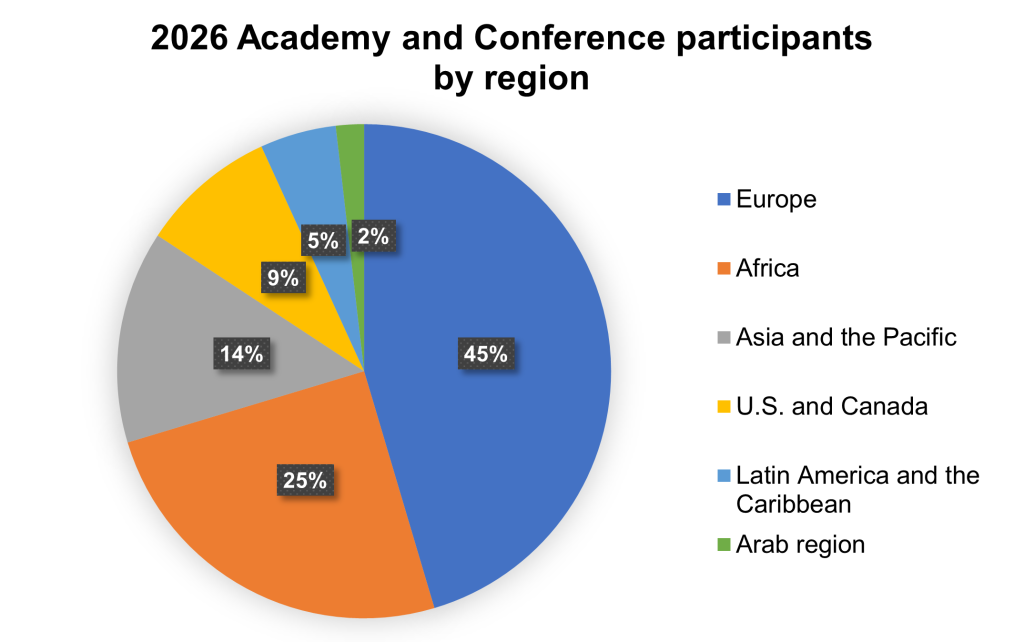
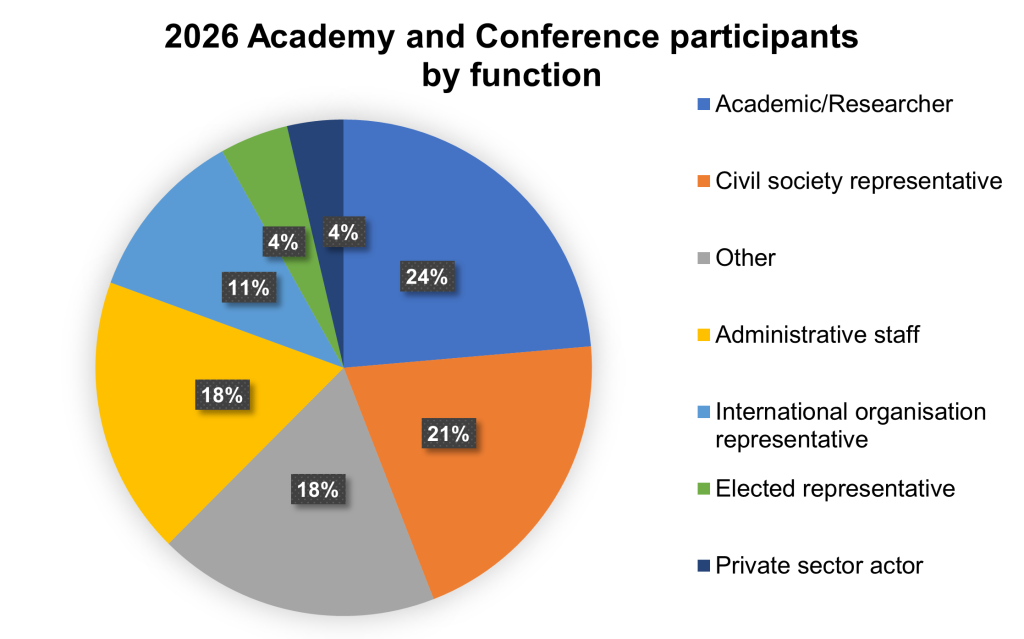
The event convened representatives of local governments (policy-making and public administration) and city networks, alongside human rights professionals and practitioners from think tanks, universities, civil society, and international organizations. The 2026 edition’s participants were notably diverse, welcoming attendees from various places and all continents. A particular highlight was the “Next Generation” mentoring session for students, early-career professionals, and those interested in a new career in the human rights field. In total, the fifth “Human Rights Go Local” Academy and Conference reached over 400 participants.
Important documents (pdf files):
The 2026 edition of the Academy and Conference was organised in collaboration with:
United Nations Educational, Scientific and Cultural Organization (UNESCO), United Nations Human Settlements Programme (UN-Habitat), the United Nations Office of the High Commissioner for Human Rights (OHCHR), the Congress of Local and Regional Authorities of the Council of Europe, United Cities and Local Governments (UCLG), the African Local Governments Academy (UCLG-Africa), the Austrian Federal Ministry of European and International Affairs, the Federal Province of Styria, the City of Graz, and the University of Graz.

